Global Recycled Standard (GRS)
The Global Recycled Standard (GRS) is an international, voluntary, and comprehensive product standard that sets third-party certification requirements for recycled content, chain of custody, social and environmental practices, and chemical restrictions. The goal of the GRS is to increase the use of recycled materials in products and reduce/eliminate the harm caused by their production. This standard applies to all companies (entities) that produce or sell GRS products. This includes all products processed, manufactured, packaged, labeled, sold, and used that contain at least 20% recycled material. The GRS certification system can be applied to all units in the supply chain, including all processing units up to business-to-business (B2B) transactions with the final buyer.
Today, the GRS has been propelled throughout the entire industrial chain by brands such as ZARA, H&M, ADIDAS, Uniqlo, NIKE, IKEA, and GAP, connecting all aspects of the supply chain (from raw materials - production and processing - trading brands), from the brand owners down to the fabric merchants. It is currently the most prominent "order passport" in the certification field.
The Global Recycled Standard (GRS) applies to any product containing at least 20% recycled material.
Details of GRS Certification Supervision
GRS differs from other environmental certifications: GRS involves the traceability of the entire chain of custody, starting from the pellet manufacturing source all the way to the final retail brand. Every stage of the supply chain through which the product flows must hold GRS certification to ensure supervised confirmation.
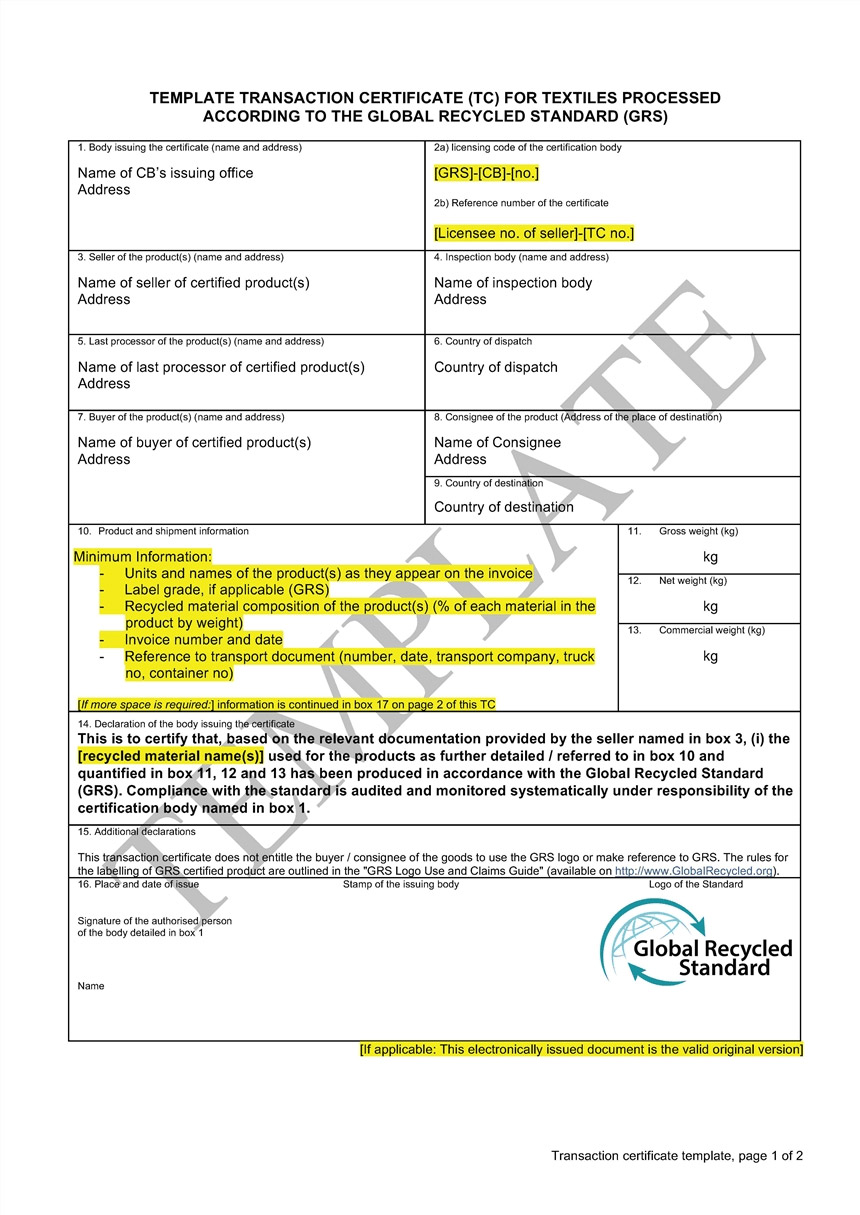
To receive orders and ship goods normally, in addition to the GRS certificate, a Transaction Certificate (TC) is also required. One type of TC is issued by the upstream supplier, while another is obtained from the certification body after receiving the GRS certificate.
The Transaction Certificate (TC) serves as proof of raw material traceability under GRS. It functions as a certificate for a specific batch of goods (displaying specific information such as product type, content, weight, etc.). From the product's origin to the final trader, the upstream party must issue a TC to the downstream party for each link in the chain. Transactions at every stage of the supply chain must have the corresponding TC issued within the specified timeframe.
GRS Audit Scope: 4 Main Sections
1. Recycled Content Verification
2. Social Responsibility
3. Environmental Management
4. Chemical Management
Why choose the GRS?
Sustainable materials: The GRS promotes the use of recycled materials, which helps to reduce the need for new raw materials and reduce the environmental impact of waste.
Social and environmental standards: The GRS ensures that products carrying the standard meet certain social and environmental criteria. This includes aspects such as compliance with labour standards and minimizing environmental impacts during the manufacturing process.
Transparency: With the GRS, brands and consumers can be sure that the origin of the recycled materials can be traced back to the place of origin.